

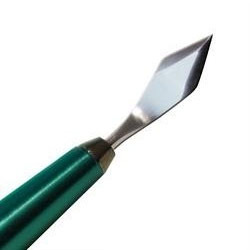
Keratome Blades
0.20 - 0.30 USD ($)/Box
Product Details:
- Storage Instructions Store in dry, clean environment away from sunlight
- Sterile Yes
- Weight Approx. 2g (with handle)
- Set Contains Single Blade per Pack
- Usage & Applications Ophthalmic Surgery, Cataract Surgery, Corneal Incision
- Shelf Life 5 Years
- Size Varies (1.1 mm, 2.2 mm, 2.8 mm, 3.0 mm, 5.0 mm)
- Click to View more
X
Keratome Blades Price And Quantity
- 0.20 - 0.30 USD ($)/Box
- 10 Box
Keratome Blades Product Specifications
- Varies (1.1 mm, 2.2 mm, 2.8 mm, 3.0 mm, 5.0 mm)
- No
- Store in dry, clean environment away from sunlight
- No
- Surgical Grade
- No
- Yes
- 1.1 mm, 2.2 mm, 2.8 mm, 3.0 mm, 5.0 mm (Available Options)
- Angled / Slit / Crescent
- Yes
- Ergonomic
- Single Blade per Pack
- Stainless Steel (Blade), Medical Grade Plastic (Handle)
- Ophthalmic Surgery, Cataract Surgery, Corneal Incision
- Silver (Blade), Blue/White (Handle)
- 15 mm to 20 mm (Blade Length)
- Yes
- Approx. 2g (with handle)
- Other
- 5 Years
- Other
- Latex Free
- Phacoemulsification, Clear Corneal Incision, Scleral Tunnel Incision
- ISO 9001:2015 & CE Marked
- Lightweight, Non-slip Grip
- Ultra-sharp, Consistent Cutting Edge
- Non-reusable
- No (EO Gas used)
- Sharp, Micro-fine
- Individually Blister Packed
- Precision Point
Keratome Blades Trade Information
- Mumbai International Airport
- Cash on Delivery (COD), Letter of Credit (L/C), Paypal, Western Union, Letter of Credit at Sight (Sight L/C), Cash Against Delivery (CAD), Telegraphic Transfer (T/T), Delivery Point (DP), Days after Acceptance (DA), Cash in Advance (CID), Cheque, Cash Advance (CA)
- 10000000 Box Per Month
- 5 Days
- Contact us for information regarding our sample policy
- Western Europe, Australia, North America, Eastern Europe, Middle East, Central America, South America, Asia, Africa
- All India
- CE Certify.
Product Description
The normal human cornea varies from around 500 to 600 micrometres in thickness; and in the LASIK procedure, the microkeratome creates an 83 to 200 micrometre thick flap. This piece of equipment is used all around the world to cut the cornea flap. The microkeratome is also used in Descemet stripping automated endothelial keratoplasty, where it is used to slice a thin layer from the back of the donor cornea, which is then transplanted into the posterior cornea of the recipient. It was invented by Jose Barraquer and Cesar Carlos Carriazo in the 1950s in Colombia.
Exceptional Precision and Safety
Keratome Blades provide unmatched precision for ophthalmic and cataract surgeries. The ultra-sharp, stainless steel blade with a micro-fine, sharp tip facilitates smooth and controlled incisions. Medical professionals can count on high performance and safety, as each blade is latex-free, fully sterilized using EO gas, and meets rigorous ISO 9001:2015 and CE quality standards.
Versatile Applications and User-focused Design
Our blades come in several sizes and shapes, including angled, slit, and crescent options, suitable for a range of procedures like phacoemulsification, clear corneal, and scleral tunnel incisions. The ergonomic, non-slip handle and lightweight, approximate 2g design ensure comfort and precise maneuvering during critical surgical steps.
FAQ's of Keratome Blades:
Q: How do I use Keratome Blades during ophthalmic surgery?
A: Keratome Blades are designed for single-use in ophthalmic surgeries. After unblistering the sterile pack, use the blade to create precise incisions such as clear corneal or scleral tunnel cuts. Ensure you select the appropriate width and shape for the procedure, and dispose of the blade safely after use.Q: What procedures are these blades suitable for?
A: These blades are compatible with phacoemulsification, clear corneal incision, and scleral tunnel incision procedures in ophthalmic and cataract surgeries, thanks to their precision point design and ultra-sharp cutting edge.Q: When should Keratome Blades be used in the surgical process?
A: Keratome Blades are typically employed at the initial phase of cataract and corneal surgeries, during the creation of incisions to access ocular structures, ensuring minimal trauma and precise entry.Q: Where should the blades be stored for optimal preservation?
A: Store Keratome Blades in a dry, clean area away from direct sunlight to maintain their sterility and extend their five-year shelf life.Q: What are the benefits of the non-slip ergonomic handle design?
A: The lightweight and ergonomic handle, constructed from medical grade plastic, provides a secure, non-slip grip, improving control and reducing surgeon fatigue during lengthy and delicate procedures.Q: Are the blades reusable, and how should they be disposed of?
A: Keratome Blades are non-reusable and non-recyclable. Each should be safely discarded after a single use according to standard biohazard disposal procedures to prevent cross-contamination.Tell us about your requirement

Price:
Quantity
Select Unit
- 50
- 100
- 200
- 250
- 500
- 1000+
Additional detail
Mobile number
Email

Other Products in 'Surgical Product' category

Contact Details
SAINTROY LIFESCIENCE LLP
GST : 24AFBFS1718M1ZX
GST : 24AFBFS1718M1ZX
- 4th Floor, Shop No. 408, Silver Point, Near Devi Darshan Society, Silver Chowk, PunaSurat - 395010, Gujarat, India
- Phone : 08071630660
- Mr Vishal N Kathiriya (Proprietor)
- Mobile :08071630660
-
 Send Inquiry
 Send Inquiry
Quick Inquiry
 |
SAINTROY LIFESCIENCE
All Rights Reserved.(Terms of Use) Developed and Managed by Infocom Network Private Limited. |
