

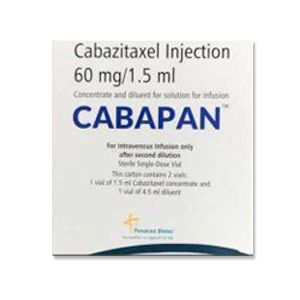
Cabazitaxel Injection
1 USD ($)/Box
Product Details:
- Dosage Form Injection
- Salt Composition Cabazitaxel
- Indication Treatment of metastatic castration-resistant prostate cancer
- Enzyme Types Other
- Feature Other
- Ingredients Cabazitaxel, polysorbate 80, citric acid monohydrate, sodium citrate dihydrate, ethanol, water for injection
- Application Other
- Click to View more
X
Cabazitaxel Injection Price And Quantity
- 1 USD ($)/Box
- 100 Box
Cabazitaxel Injection Product Specifications
- Other
- 3.7-4.5
- Clear colorless to pale yellow solution
- 2 Years
- Injection
- Store at cool and dry place.
- Other
- Other
- Treatment of metastatic castration-resistant prostate cancer
- Cabazitaxel
- Normal Smell
- Cabazitaxel, polysorbate 80, citric acid monohydrate, sodium citrate dihydrate, ethanol, water for injection
- Dilute with 0.9% Sodium Chloride or 5% Dextrose before administration
- Prescription only
- Intravenous infusion
- 60 mg/1.5 ml
- Single vial
- For cytotoxic use only, handle with care
Cabazitaxel Injection Trade Information
- surat
- Cash Against Delivery (CAD), Cash on Delivery (COD), Cash Advance (CA), Letter of Credit (L/C), Paypal, Western Union, Letter of Credit at Sight (Sight L/C), Delivery Point (DP), Telegraphic Transfer (T/T), Days after Acceptance (DA), Cash in Advance (CID), Cheque
- 1000000 Box Per Month
- 4 Days
- Contact us for information regarding our sample policy
- 1 Vail
- Western Europe, North America, South America, Eastern Europe, Middle East, Central America, Asia, Australia, Africa
- Chandigarh, Himachal Pradesh, Andaman and Nicobar Islands, Uttarakhand, Daman and Diu, Dadra and Nagar Haveli, Lakshadweep, Nagaland, South India, East India, West India, Andhra Pradesh, Assam, Arunachal Pradesh, Bihar, Goa, Jammu and Kashmir, Jharkhand, Madhya Pradesh, Maharashtra, Mizoram, Meghalaya, Manipur, Punjab, Pondicherry, Sikkim, Tamil Nadu, Telangana, Tripura, West Bengal, Haryana, Delhi, Gujarat, Rajasthan, Karnataka, North India, Kerala, Central India, Odisha, Chhattisgarh, Uttar Pradesh, All India
- ISO/GMP/c-GMP/WHOGMP/USFDA/EUGMP.
Product Description
Since last manyyears Saintroy Lifescience is leading manufacture, export and supplierofCabazitaxel Injectionfrom Surat, Gujarat, India. Cabazitaxel Injection use of cabazitaxel after the approval of using it in the treatment ofdocetaxel-refractory mCRPC.
Tags: Cabazitaxel Injection manufacturer, Cabazitaxel Injection exporter,Cabazitaxel Injection supplier, and Cabazitaxel Injection, whogmp approved Cabazitaxel Injectionmanufacturer and supplier, Cabazitaxel Injection distributor, Cabazitaxel Injectionshipper, Cabazitaxel Injection 1.5 ml Cabazitaxel Injection 1.5 ml supplier,Cabazitaxel Injection 1.5 ml.
ISO/GMP/cGMP/WHOGMP/NAFDAC approved, PPB Kenya approved/USFDA approved/EUGMP approved/MOH Iran approved manufacturing facility inGujarat, India.
Registration: Saintroy Lifescience is interested inregistration of own brand or customer brands in ministry of health of clientscountry and we also provide the products samples, COA, COPP, ACTD or CTD dossier, DMF, Manufacturing license, Free sales certificate and other required documents.
Export Country :Saintroy Lifescience Cabazitaxel Injectionexport to USA, Canada, Germany, Europe, France, Ghana, Nigeria,Kenya, Senegal, Sudan,UAE, Kuwait, Dubai, Cameroon, Lebanon, Peru, Chile,Somalia, Philippines, Myanmar, Maldives, Thailand, Singapore, Malaysia, HongKong, China, Zimbabwe, Togo, Burkina Faso, Niger,Guinea Bissau, Congo,Democratic of republic, Ivory Costa, Oman, Guatemala, Nicaragua, Salvador,Qatar, Costa Rica, Panama, Cuba, Colombia, Bolivia, Argentine, Algeria, Guyana,Morocco, Jordan, Bahrain, Iran, Egypt, Kyrgyzstan, Uzbekistan, Kazakhstan.
How Cabazitaxel Injection Works
Cabazitaxel disrupts the normal function of microtubules within cancer cells. By interfering with these cell components, it inhibits cell division and leads to the death of cancerous cells, providing a therapeutic option for patients with metastatic castration-resistant prostate cancer who have progressed after standard treatments.
Proper Administration and Handling
This injection must be administered by qualified healthcare professionals through intravenous infusion. Due to its cytotoxic properties, strict handling protocols should be followed, including proper dilution in saline or dextrose prior to administration. Special attention is necessary to avoid accidental exposure and ensure patient safety.
FAQ's of Cabazitaxel Injection:
Q: How should Cabazitaxel Injection be prepared and administered?
A: Cabazitaxel Injection must be diluted with either 0.9% Sodium Chloride or 5% Dextrose before intravenous infusion. Preparation and administration must be performed by a healthcare provider trained in handling cytotoxic medications.Q: What is Cabazitaxel Injection used for?
A: This injection is indicated for the treatment of metastatic castration-resistant prostate cancer, particularly in patients who have experienced disease progression after prior treatment.Q: When should Cabazitaxel Injection not be used?
A: Cabazitaxel Injection should not be used without a prescription or supervision by a qualified healthcare provider. It is contraindicated in patients with severe hypersensitivity to Cabazitaxel or any of its components.Q: Where should Cabazitaxel Injection be stored?
A: It should be stored in a cool, dry place, away from direct sunlight and out of reach of children, to maintain stability and efficacy during its 2-year shelf life.Q: What benefits does Cabazitaxel Injection offer?
A: Cabazitaxel provides an alternative treatment for men with advanced prostate cancer when standard hormone-based therapies have failed, potentially prolonging life and reducing symptoms.Q: What precautions should be taken while handling Cabazitaxel Injection?
A: As a cytotoxic medication, Cabazitaxel requires careful handling using gloves and protective equipment to avoid accidental exposure. Only trained personnel should prepare and administer the injection.Q: What does the solution look and smell like?
A: Cabazitaxel Injection is a clear, colorless to pale yellow solution and may have a normal fermentation-like smell, which is typical and should not be considered a defect.Tell us about your requirement

Price:
Quantity
Select Unit
- 50
- 100
- 200
- 250
- 500
- 1000+
Additional detail
Mobile number
Email

Other Products in 'Anticancer Injection' category

Contact Details
SAINTROY LIFESCIENCE LLP
GST : 24AFBFS1718M1ZX
GST : 24AFBFS1718M1ZX
- 4th Floor, Shop No. 408, Silver Point, Near Devi Darshan Society, Silver Chowk, Puna, Surat, Surat, Gujarat, 395010Surat - 395010, Gujarat, India
- Phone : 08071630660
- Mr Vishal N Kathiriya (Proprietor)
- Mobile :08071630660
-
 Send Inquiry
 Send Inquiry
Quick Inquiry
 |
SAINTROY LIFESCIENCE
All Rights Reserved.(Terms of Use) Developed and Managed by Infocom Network Private Limited. |
